 Spontanika
Vitamin C for your brain
Keep talking,
without stopping
The announcer names a random word — and you talk about it until the next one arrives. Twenty minutes of this loosens the tongue far better than any theory of public speaking.
What this is
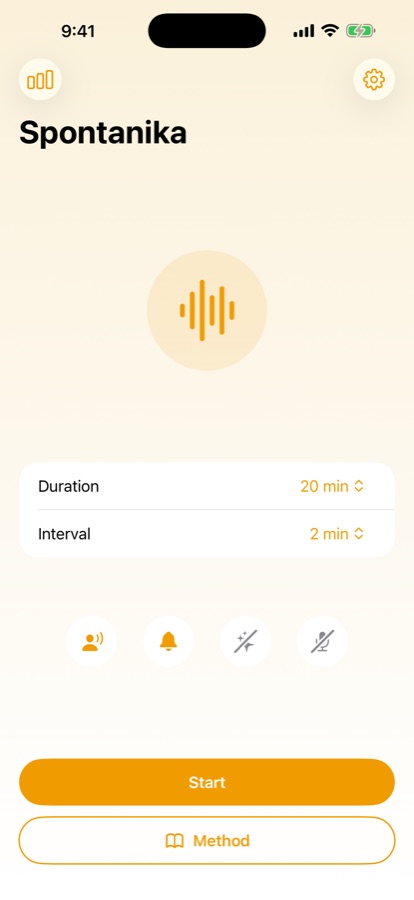
Spontanika is an exercise in spontaneous speech, devised in 2014 and refined over hundreds of sessions since. The premise is simple: you do not prepare, you do not pick the topic, and you have no time to think an answer through. The word comes from outside, and you have to speak at once — out loud, firmly, with no "uhm" and no inner editing.
After a few sessions something characteristic happens: words stop being invented and start arriving on their own. That moment — when speech runs ahead of thought — is the whole point of the practice.
How a session goes
- Pick a duration and an intervalTwenty minutes with the word changing every two is the usual place to start.
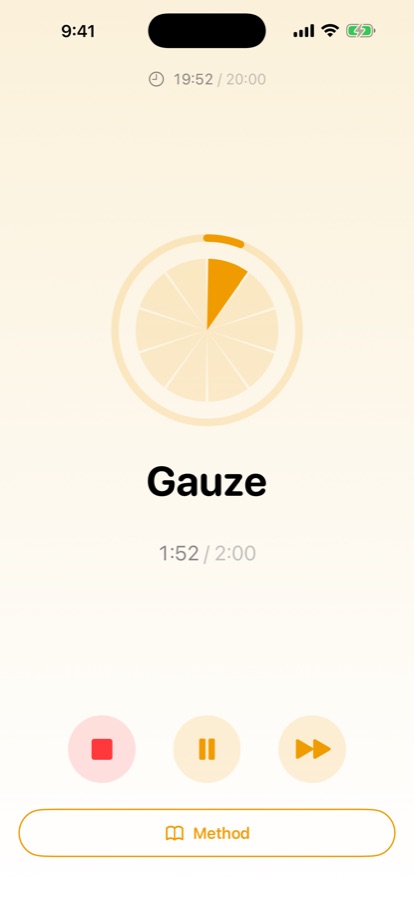
- The call-sign sounds, the announcer names a wordOne of eleven chimes warns you of the change, then the word is spoken aloud. The screen can flash instead — for practising in silence.
- You speak until the word changesWithout stopping and without judging what you just said. The app keeps time and watches the interval for you.
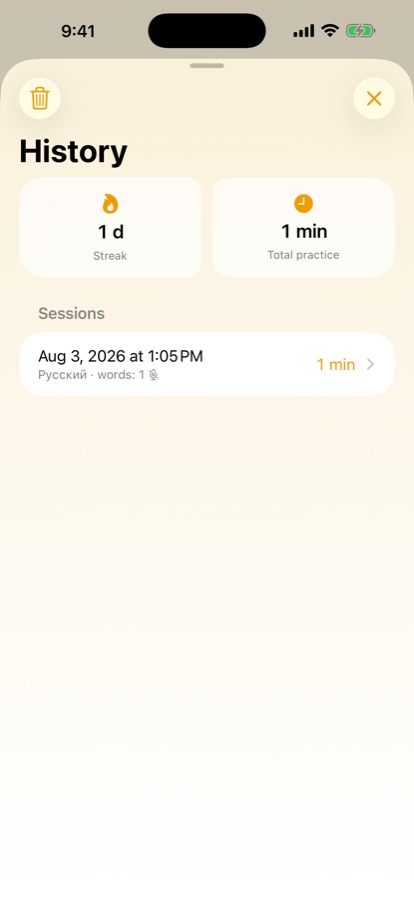
- Speech is recognized on the phone itselfOptional: what you said is stored in the history word by word, with your pace and filler-word count. Nothing is uploaded anywhere.
The whole point
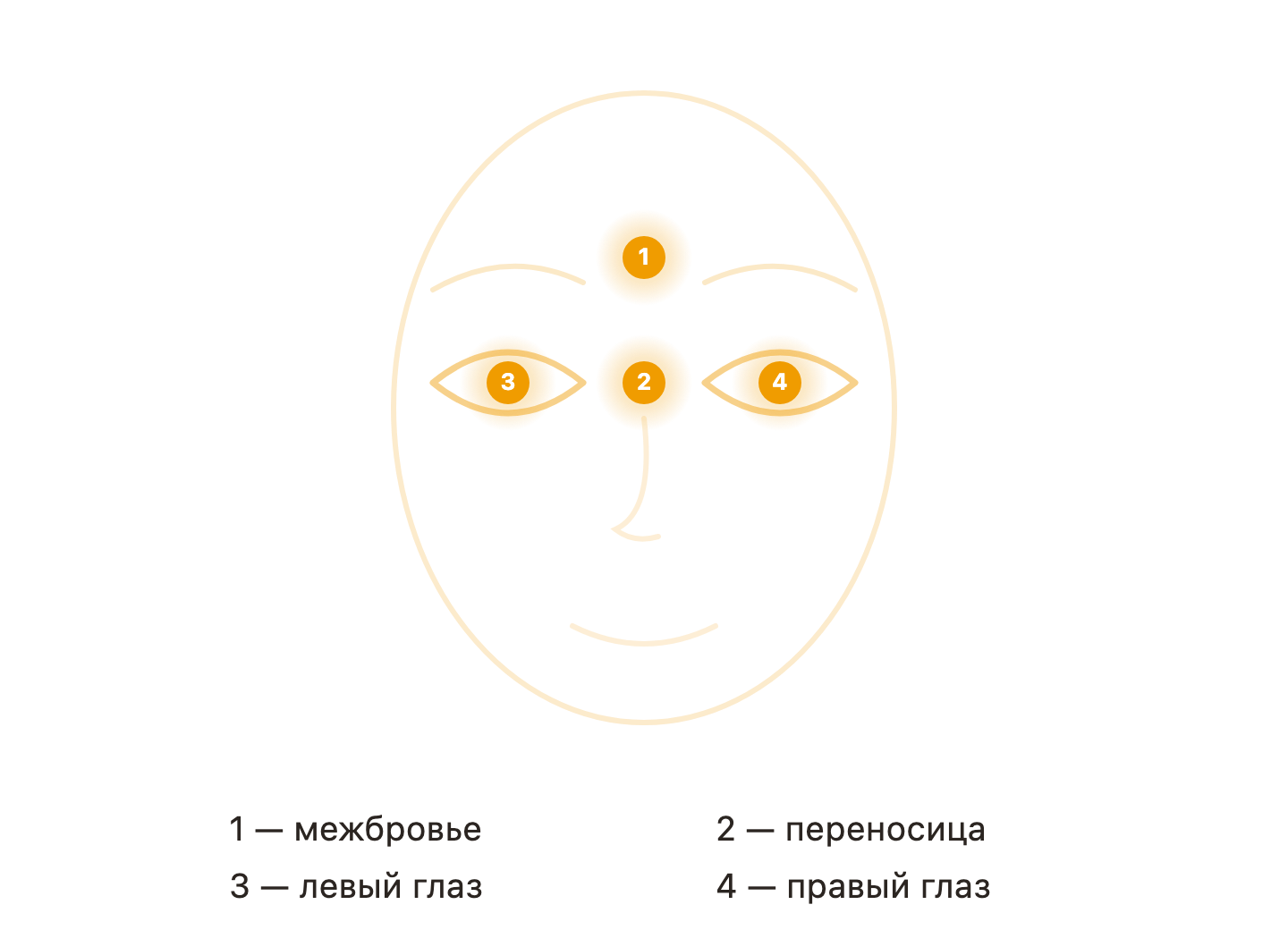
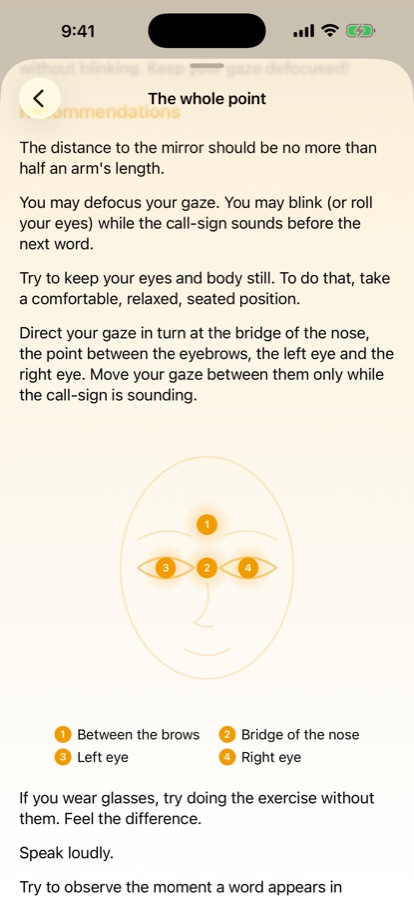
The exercise has one condition without which it does not work: hold your gaze — on yourself in a mirror or on your partner — without looking away and without focusing. The gaze moves between four points, and only while the call-sign is sounding.
Three exercises and experiments
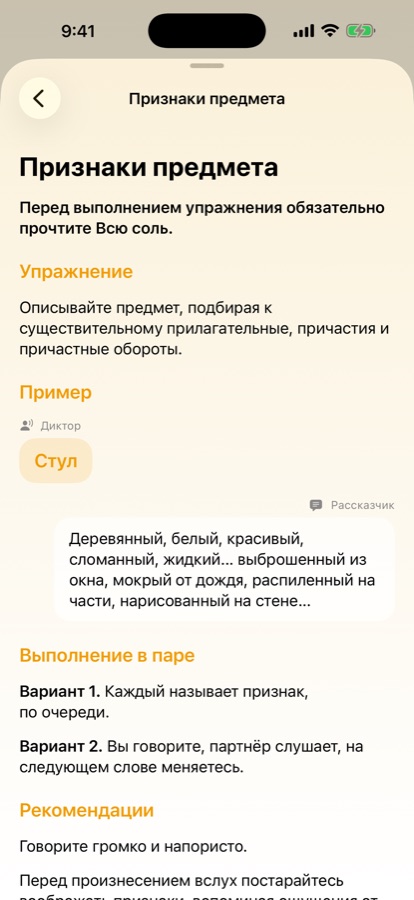
Attributes of an object
You find adjectives and phrases for the word: wooden, thrown out of the window, painted on the wall.
Speaking as the object
"I am a watermelon." From there, about yourself as that object: what you feel, what you know, what you like.
About the object
Everything you know and do not know about the word. Here it shows most clearly how speech outruns a prepared thought.
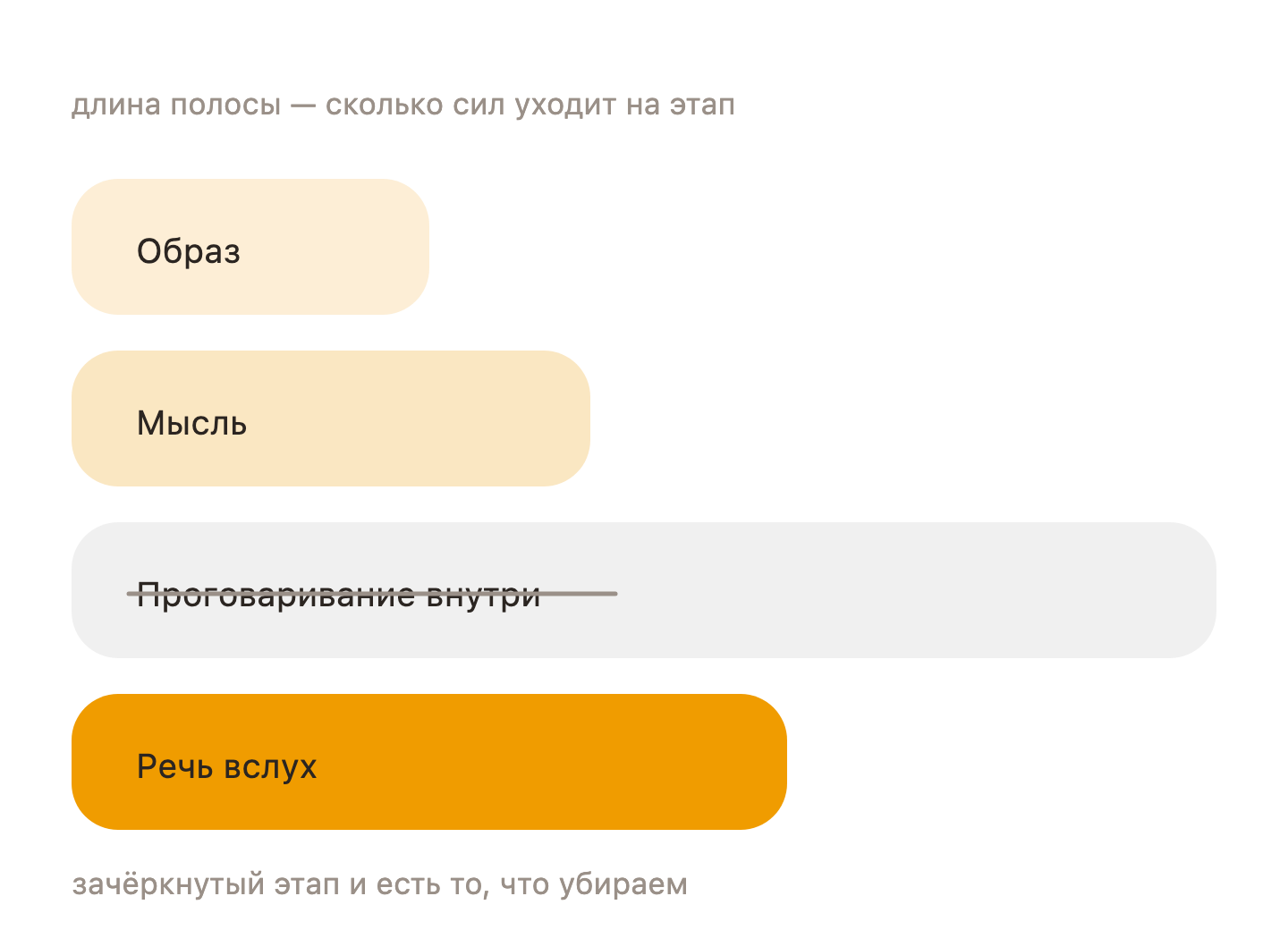
A separate chapter covers experiments: sessions two to three hours long, speech stripped of intonation, and an attempt to drop inner pronunciation — the most costly stage on a word's way out.
What is in the app
Over a thousand words
Eleven categories of nouns that form vivid images. You can add your own dictionaries.
Russian and English
Interface language, word language and the method text switch independently.
Your speech stays with you
No accounts and no server of ours: transcripts are kept on the phone alone. Recognition is done by the phone's own system — some languages on the device, the rest on its servers. Only anonymous usage statistics are collected.
History and streaks
Every session is kept: duration, words, a transcript of what you said, and your run of consecutive days.
Lock screen
The word and both timers appear in a Live Activity; headphones change words.
The full method
The same 2014 text as the original — with diagrams and examples, right inside the app.